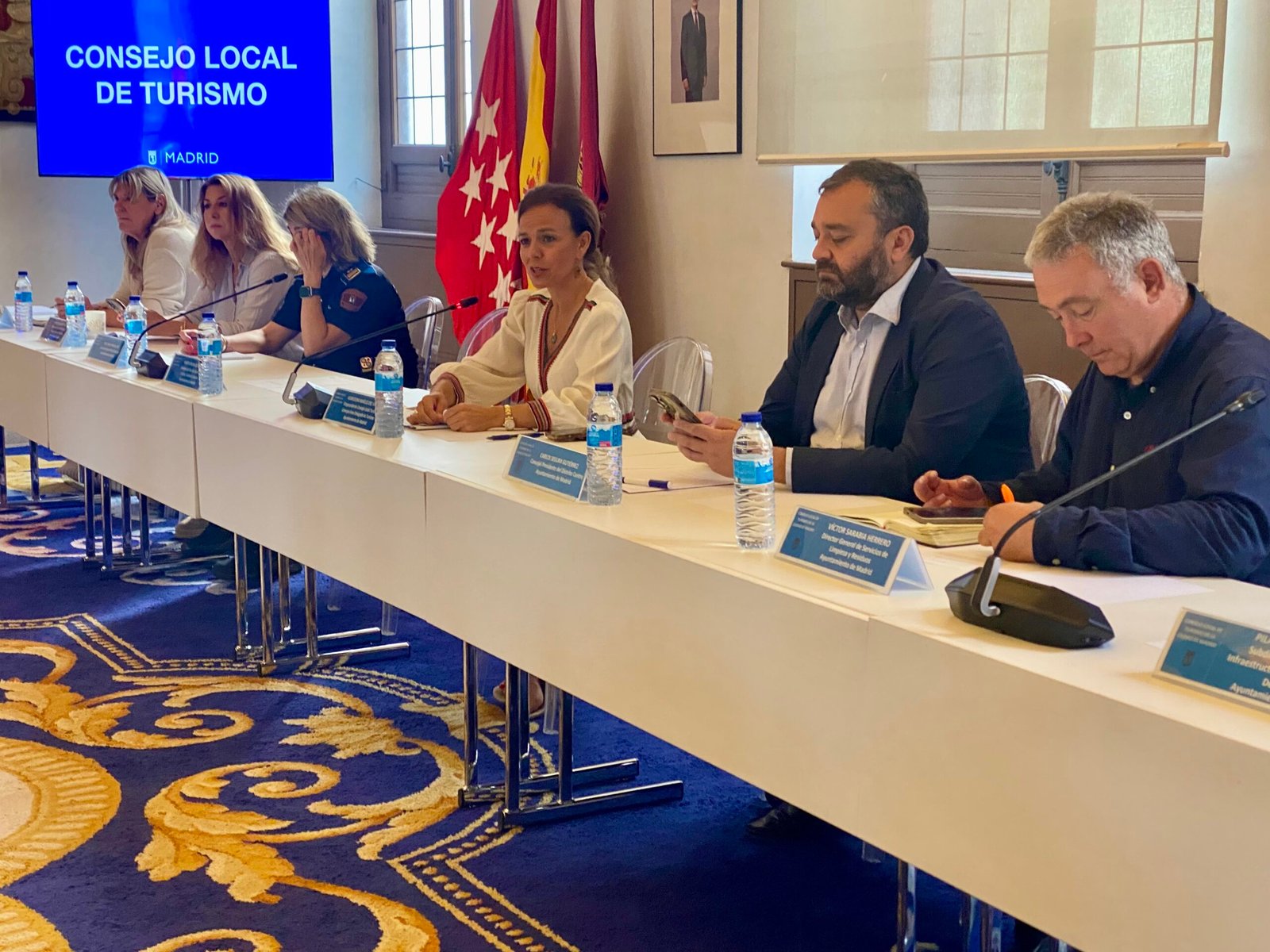
The Local Tourism Council of the City of Madrid, chaired by the delegate councilor for Tourism, Almudena Maíllo, has conducted a morning assessment of tourism in the capital during the first half of 2025. The session was attended by 48 representatives from the Madrid tourism sector, presenting visitor data, key action lines in the area, and the most significant milestones of the year in terms of decentralization, seasonality, international promotion, and digitization, among others.
The delegate councilor highlighted the main tourism data for Madrid in the first four months of the year (INE data available), where Madrid welcomed 3,464,402 visitors, with a total of 7,436,623 overnight stays. Of note is the 61% of international travelers, with significant increases in priority markets such as the United States (+5.1%), France (+5.4%), and Italy (+1%). Particularly noteworthy are the Ibero-American markets like Argentina, with a growth of 27.3%, and Brazil, with +21.2%.
For Maíllo, "2025 shows us that Madrid’s tourism is consolidating as a quality model thanks to two main pillars: decentralization and seasonality." According to the delegate councilor for Tourism, "the capital is alive 365 days a year and can be discovered in all its areas," emphasizing that "Madrid’s great competitive advantage lies in offering authentic experiences to visitors, as well as in public-private collaboration."
During the session, Maíllo addressed the progress in implementing the Tourism Strategic Plan 2024-2027, focused on seasonality and decentralization of tourism. In this regard, she emphasized the key role of sporting, musical, and popular events in activating the city year-round. Among them, the delegate councilor highlighted the Formula 1 Grand Prix, to be held from September 11 to 13, and the NFL regular season game in November, as well as Madrid’s leadership as the world capital of Spanish-language musicals and the promotion of Holy Week, aspiring to be declared a Regional Tourist Interest.
Madrid’s Tourism Decentralization Plan
In the realm of decentralization, the City of Madrid has launched the ‘You’re missing streets’ campaign and defined 22 priority tourism zones in a first phase, to be joined by nine new areas. This strategy is complemented by initiatives like ‘Come live it,’ which, in its second edition, will conduct five tapas routes organized by Hostelería Madrid and Mahou San Miguel.
The Council was also informed about the renewal of the joint strategy Madrid Tourism by IFEMA Madrid, with an investment of 38.4 million euros until 2027, resulting in a 14% increase in the arrival of international tourists to the city and a 12.5% rise in daily average spending since 2019.
Additionally, the City of Madrid has reinforced its international strategy in the Ibero-American market, with promotional activities in Mexico City, Lima, Rio de Janeiro, and São Paulo. These actions include participation in ILTM Latin America 2025, the Spain Única event by Turespaña, and a joint promotion agreement with Seville, involving an institutional trip to the Mexican market.
Maíllo pointed out that "Madrid is solidifying its position as the major air connectivity hub between Latin America and Europe, with 66 routes connecting it to 32 Latin American destinations, enhancing its competitiveness as a long-haul destination."
The session also shared the approval by the City of Madrid of the RESIDE Plan. This pioneering initiative aims to regulate the phenomenon of tourist housing and protect local commerce and neighborhood coexistence.
In terms of sustainability and tourism information, the delegate councilor for Tourism addressed the awarding of technical assistance contracts for measuring, reducing, and offsetting the carbon footprint of Madrid’s tourism, within the Sustainable Tourism Plan financed by NextGenerationEU funds. Additionally, Maíllo referenced the new Accessible Guided Tours program and the handling of over 570,000 inquiries at municipal tourist information points so far this year.
In the realm of screen tourism, Madrid Film Office presented the tenth tourist route titled ‘Sound Images of Madrid,’ in collaboration with Argentine composer and two-time Oscar winner Gustavo Santaolalla and the TAI University School of Arts. Furthermore, the artificial intelligence project VisitMadridGPT, already present in 125 countries, continues to drive tourism digitization with an average of three questions per user and over four minutes of average browsing time.
Tourism and Quality of Life Table of Usera
During the session, the conclusions of the Tourism and Quality of Life Table of the Usera district were presented, gathering proposals from the residential, commercial, academic, and cultural spheres. The City of Madrid reaffirmed its commitment to a sustainable, inclusive, decentralized tourism model that respects the district’s identity.
The Council also learned about the progress of the Sports Tourism Working Group, coordinated by the Delegated Sports Area. The creation of specific committees to coordinate sports events to position Madrid as the capital of sports was highlighted.
Among the upcoming sports milestones, the plan for the Tour of Spain cycling race, celebrating its 90th anniversary this year, was presented. Additionally, the impact of the Madrid Marathon, held on April 27, which attracted 45,000 runners from 118 countries, with a 27% foreign participation and an estimated economic impact of 64.5 million euros. The race had a potential audience of 400 million people.
The session was also attended by the delegate for Culture, Tourism, and Sports, Marta Rivera de la Cruz, and the councilor for Centro, Carlos Segura, as well as associations and companies such as CEIM-CEOE, AEHM, Hostelería Madrid, APIT, Las Llaves de Oro, ALSA, El Corte Inglés, Las Letras Street, Salamanca District 41, Madrid Convention Bureau, UCM, Nebrija University, Thyssen-Bornemisza National Museum Madrid, Madrid Gastronomy Academy, and Madrid Artisans Association.
Rivera de la Cruz referred to the ‘Madrid, full of culture’ program, aiming to convey the cultural offerings to an international audience to position Madrid as a cultural destination of reference. To achieve this, specific training for tourist information providers, the generation of monthly newsletters, and the creation of audiovisual content will be developed. Collaboration with the artistic directors of municipal cultural spaces to identify shows suitable for international audiences is also in progress. /