The works to bury the Paseo de Extremadura (A-5) and transform it into the Southwest Green Walk continue. Yesterday, the demolition of the vehicle underpass slab connecting Seseña Street with Boadilla del Monte Road was completed, a necessary action to build the tunnel that will bury the 80,000 vehicles that daily cross the highway. A small cable area has been left, which will be compatible with the execution of the underground works.
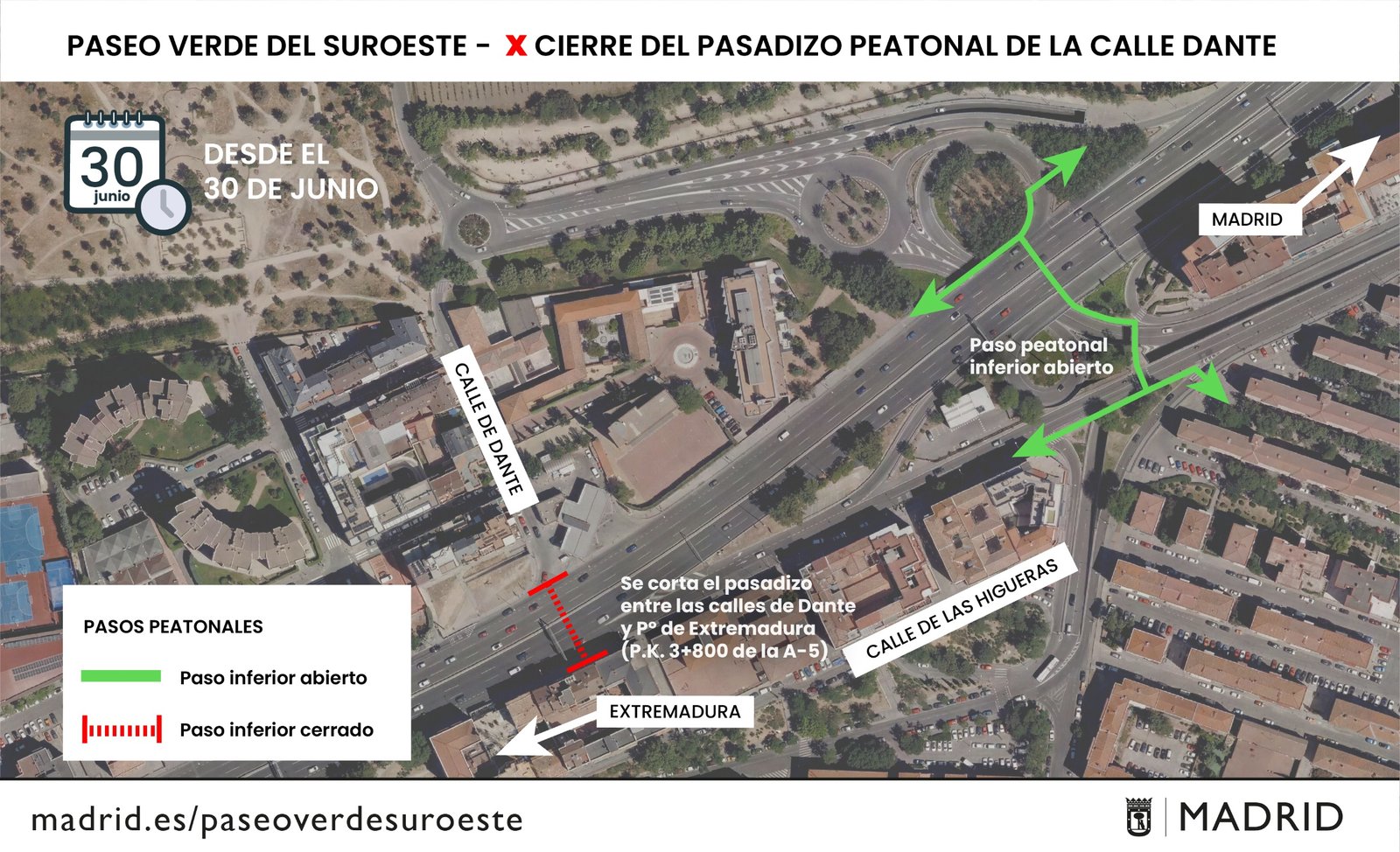
Next Monday, the Urbanism, Environment, and Mobility Area, led by Borja Carabante, will close the last of the six pedestrian-only crossings in the section where the burying works are taking place. This is the Dante passageway, located between Dante Street and Paseo de Extremadura (P.K. 3+800 of the A-5). Its closure is necessary to continue with the execution of the piles – 58% of the total has already been built (4,078 out of 7,000) – and the slabs that will form the future tunnel.
The existing pedestrian link at the Parque de Atracciones junction is recommended as an alternative route. Residents of the Campamento and Aluche neighborhoods will still have access to the underpass on Padre Piquer Avenue and the Anillo Verde Ciclista footbridge.
Regarding the four mixed underpasses, the one linking to Boadilla Road has been closed, but the Yébenes, Batán, and Parque de Atracciones road links remain open, allowing connection between the Lucero and Batán neighborhoods. Their progressive closure is expected to take place throughout the summer as work progresses.
An Urban Transformation Intervention
With the implementation of the Southwest Green Walk and the consequent burying of the A-5, the Madrid City Council will reclaim the space currently occupied by the highway that separates the Lucero, Aluche, and Las Águilas neighborhoods from Campamento and Casa de Campo (the latter belonging to the Moncloa-Aravaca district). 80,000 vehicles traveled daily on the A-5. Once completed, the project will reduce surface vehicles and pollutant emissions by 90%.
On the surface, the covering of the A-5 will allow the pedestrianized boulevard of Portugal Avenue to continue to Padre Piquer Avenue in a total 3.2-kilometer intervention. Pedestrian and cycling mobility will be prioritized, with a roadway designed to serve local private vehicle and urban public transport journeys.
Underground, the new tunnel will have a distribution of three lanes per direction in two spans. The lanes closest to the median on both carriageways are designed for use as bus-VAO lanes, equipped with variable signage to regulate their use according to traffic needs at any given time. The flexibility of this system will optimize the infrastructure, adapting to transportation demand variably.
The project, mobility plan, and alternative routes can be consulted at: www.madrid.es/paseoverdesuoreste